
Put It in Writing

The gripe nobody says out loud
Picture a staff meeting in the middle of a big change. Someone is clicking a pen. Someone else has their camera on but their eyes on another window. I ask, brightly, "Any concerns before we move on?"
Silence. Then: "Nope. We're good."
We were not good.
I've led through enough change to know the sound of a gripe that hasn't been said. It sounds like a quick "Sure." It looks like a calendar invite accepted without a comment, a shrug by the confrencc room door, a person who used to linger after meetings and now leaves the office first. The grievance doesn't disappear because nobody voices it. It just goes underground, where it quietly does its work — pulling us apart rather than together.
Same change, different views
Change strains work relationships for a reason that has nothing to do with anyone being difficult. In a season of real change — a new building, a new strategy, a staffing shift, a funder who rewrites the rules — each person on a team is standing in a slightly different spot. From one spot, the change looks like a door swinging open. From another, it looks like one more box landing on a desk that was already full. Someone sees the possibility; someone else sees the pothole.
Both are right.
The trouble is that most of us are better at feeling the gap than naming it. The person who sees possibility starts to read the person who sees challenges as negative. The person who sees challenges starts to read the enthusiast as naive — or worse, as not listening. Nobody says it. Everybody feels it.
As a leader, I can't make everyone see the same thing. (Believe me, I've tried. It's like herding cats who've each read a different strategic plan.) What I can do is make room for what needs to come into the open, where we can look at it together.
A frame that gives permission
That's where my GRACE framework comes in. I developed it as a way to lead through impermanence — the plain fact that every organization is always in motion. GRACE names five themes a team moves through, each one a dance between two opposing pulls:
- Gravitas: grounding ↔ letting go
- Resonance: acting ↔ reflecting
- Awareness: observing ↔ framing
- Confidence: trusting ↔ questioning
- Equilibrium: repeating ↔ interrupting
The point isn't to pick the "right" side. Healthy teams move between and balance the benefits of both. The point is to notice when you've drifted to one extreme, and to ask what it would take to steer back toward center.
While I've been using GRACE to structure conversations with my staff, what surprises me is what it gives people besides vocabulary: permission. When the question is "Where is our team right now — trusting or questioning?" nobody has to accuse anybody of anything. They're describing the team, not a colleague. The frame makes it safe to say something like, "Honestly? I think we keep repeating the same broken process because no one wants to be the one to figure a new one out."
That's a gripe. Spoken through GRACE, it's also a diagnosis — and an opening.
What changed this time
This time, I tried something different. Instead of asking the GRACE questions around a table or in a one-on-one meeting, I asked for the answers in writing. A text, a chat, an email — whatever was easiest. Just put it down.
The responses came back longer, more specific, and more honest that I've heard in quite a while. Two stood out.
When I asked the Gravitas question — what should we let go of? — one person wrote that the name of one of our regular activities no longer fit. Officially, it was something like "Client Transition Support," an abstract mouthful nobody actually said out loud. Their note pointed out that we'd all been calling it "The Handoff" for over a year, in hallways and on whiteboards, and suggested we just make it official. The new name had already won; we just hadn't written it down.
Another person took up the Confidence question — what are we trusting, and what should we be questioning? — and asked why a certain group of customers had been excluded in one of our offerings. Why had we decided to serve only our largest accounts? As I read on, I realized they had misunderstood an earlier direction. Months before, I'd said we needed to focus on our largest accounts for the quarter. I meant a short-term priority. They heard a permanent rule that shut everyone else out — and had been quietly carrying that confusion, along with a little frustration at watching the "rule" get broken by other team members. I addressed the clarification to the whole group, and saw a lot of relief in those shoulders. One written question cleared up what months of meetings hadn't.
I doubt either would have surfaced around a table or hallway talk. An activity name feels too small or maybe too large to raise. And nobody wants to say in front of colleagues, "I think I got that direction wrong" — or worse, "I think you're breaking the rules."
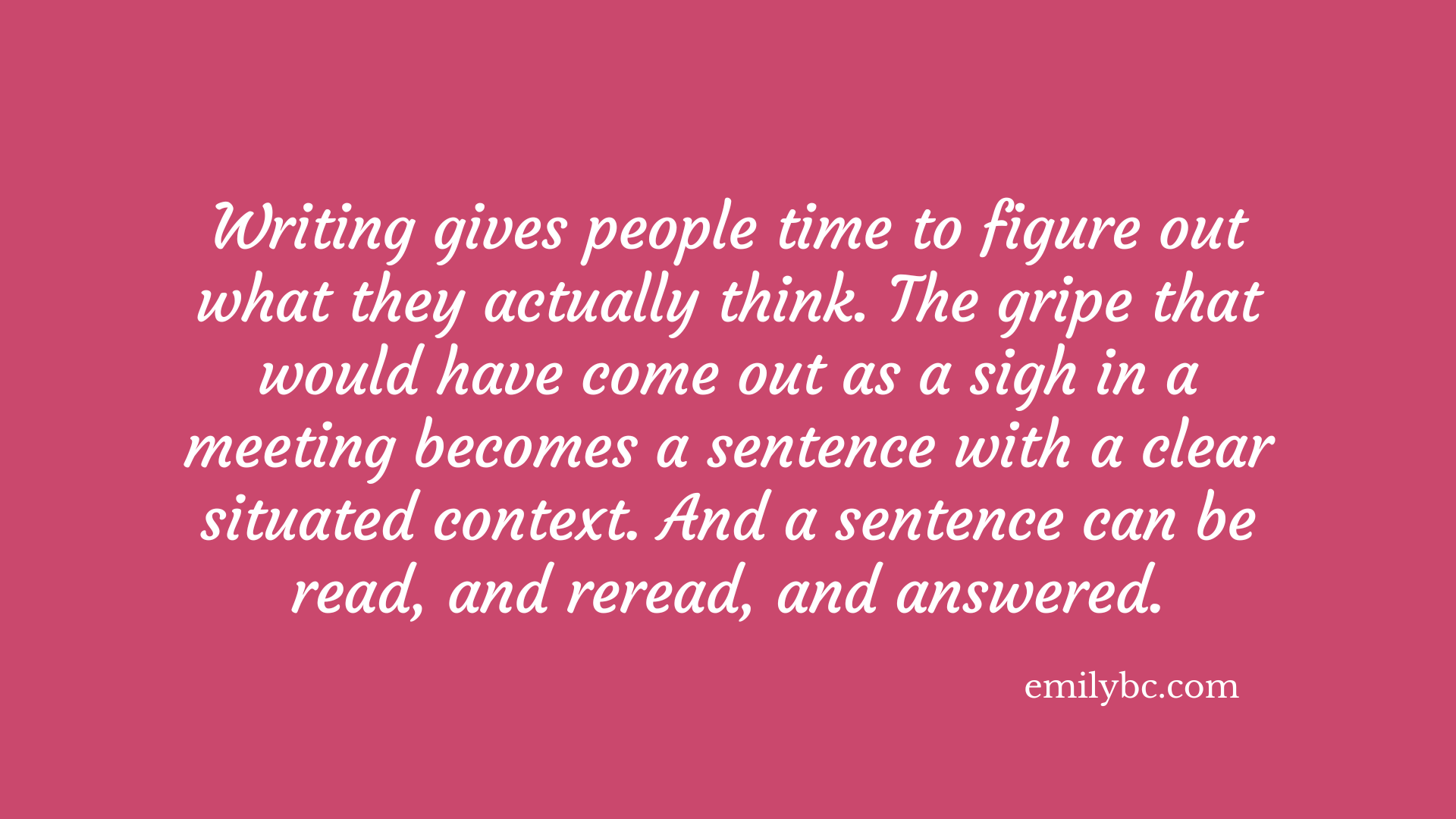
Why the difference between oral and written communication? Part of it is obvious: writing removes the performance, the immediate audience. Nobody is watching your face while you decide whether to be candid. But part of it is less obvious. Writing gives people time to figure out what they actually think. The gripe that would have come out as a sigh in a meeting becomes a sentence with a clear situated context. And a sentence can be read, and reread, and answered.
The sigh just hangs in the air.
Writing is where the thinking happens
Like many of us who are book lovers, I've been chewing on Rose Horowitch's essay in the August issue of The Atlantic, "The End of Reading Is Here." She makes a sobering case that Americans are reading far less, and less deeply, than we used to — by one national survey, fewer than half of adults read a single book in 2022 — while our attention drifts toward short video and fragments of text. As someone who runs a literacy nonprofit, I read it the way you'd read your own lab results.
But the statistics weren't what stayed with me. It was her argument, drawing on thinkers like Walter Ong and Cal Newport, that writing isn't just a way to record what we already think. It's how we find out what we think. Writing slows us down, forces our ideas into some kind of order, and shows us where our reasoning has gone soft. In her words, "Writing is hard because the writer is learning."
That is exactly what I saw in my team's notes. The writing was the thinking. And the thinking was the beginning of repair.
The memo is not busywork
This is one of my core convictions about communication at work, and I'll admit it isn't a fashionable one in the age of chats and short form video: memos, meeting notes, and reports are not busywork. They are the muscles of working together.
I know how that sounds. Nobody went into leadership dreaming of meeting minutes. And AI is changing the content and flow of this genre. But think about what a good set of notes actually does. It turns a conversation that evaporated in thin air into something the whole team can hold. It catches the decision we thought we made and reveals that we actually made two different ones. It gives the quiet person a chance and the evidence to say, "Wait — that's not what I heard."
Organizations are, in a real sense, written into being. The grant report tells a funder who we are. The board memo tells the board what we're choosing. The Monday email tells the team what matters this week. When we skip the writing, we don't save time. We just push the confusion downstream, where it's harder to see and more expensive to fix.
Grievances work the same way. An unspoken gripe is like an unrecorded decision: everyone carries a slightly different version, and the versions drift apart. Putting it in writing doesn't make the tension vanish. It makes it visible. And visible tension is something a team – and a graceful servant leader – can actually work with.
So to circle back to the discovery of asking for reflections in writing: If writing is where we do our thinking, are we giving our teams the time and permission to write — and are we willing to read what they send, and make sense of it together?
Try this: a written GRACE check-in
If your team is in the thick of change and you suspect there's more going on beneath the surface, here's a small experiment:
- Pick one GRACE pair that feels relevant right now — say, trusting ↔ questioning, or repeating ↔ interrupting.
- Send your team a short written prompt: "Where do you think our team is on these areas right now? What have you noticed that makes you say so?"
- Invite answers in whatever channel is easiest — text, chat, email. Even allow for a verbal chat if there are those who really won't respond otherwise. No required length, no wrong format.
- Read every response twice. The first time, just observe. The second time, ask yourself: what else could this mean?
- Bring the themes back to the group — not the names — and ask together: do you feel the same about this situation we find ourselves in? And what would it take to address these issues in a positive, balanced way?
You may be surprised by what people are willing to write that they'd never say out loud. I was. And I'm grateful, because those written words gave us something to read, reflect on, and build from.
Together.
Reference: Rose Horowitch, "The End of Reading Is Here," The Atlantic, August 2026.